Where Caravans Once Rested: The Ancient Trade Routes That Turned Gaziantep Into a Culinary Powerhouse
If you want to understand why Gaziantep's food is unlike anything else in the world, you have to start with geography — and then go back about two thousand years.
Situated in southeastern Turkey, Gaziantep sits at a natural crossroads between Anatolia to the north and the Fertile Crescent to the south. The Euphrates River runs nearby. The Taurus Mountains frame the horizon. For any merchant moving goods between Asia, the Middle East, and Europe, this patch of land wasn't just convenient — it was essential. And for centuries, the Silk Road ran right through it.
That history didn't just shape the city's economy. It shaped everything the city eats.
The Silk Road as a Recipe Exchange
Most Americans think of the Silk Road as a route for moving luxury goods — bolts of Chinese silk, Persian carpets, Indian spices. And it was all of that. But trade routes have always been more than commercial arteries. They're cultural pipelines, and food travels along them just as readily as merchandise.
When Arab merchants passed through Gaziantep's ancient precursor city — known in antiquity as Antiochia ad Taurum, and later simply as Antep — they brought with them the aromatic spice traditions of the Levant: cumin, coriander, sumac, and the complex layering of sweet and savory that defines much of Middle Eastern cooking. Persian traders introduced techniques for working with nuts and dried fruits in ways that elevated simple dishes into something more refined. Byzantine and later Ottoman influences added their own layers, incorporating the dairy traditions of Anatolia and the imperial kitchen's obsession with balance and presentation.
The result, over centuries of accumulation, was a culinary tradition that is simultaneously Arab, Persian, Ottoman, and Mediterranean — and somehow, distinctly its own.
It's a process that might sound familiar to American ears. Think about New Orleans: a port city where French colonists, African enslaved people, Spanish administrators, Native American communities, and Caribbean immigrants all contributed ingredients, techniques, and traditions to create a cuisine — Creole cooking — that doesn't fully belong to any single one of those groups. Gaziantep's food culture formed through a similar alchemy, just stretched across a much longer timeline and a much wider geographic web.
The Caravanserais: Where History Slept and Ate
To understand how Gaziantep absorbed all of this influence, it helps to know what a caravanserai was. These were the roadside inns of the ancient and medieval world — large, fortified rest stops where caravans could shelter their animals, store their goods, and sleep safely for the night. They were funded by rulers and wealthy merchants as acts of public service, and they were positioned at regular intervals along major trade routes.
Gaziantep had several of them. The Taşhan, a historic caravanserai in the city center, still partially stands today — its thick stone walls a quiet reminder of the thousands of travelers who once passed through. At peak periods during the medieval Silk Road era, a single caravanserai might host merchants from a dozen different cultures simultaneously. Conversations happened. Recipes were shared. A Persian merchant might watch an Arab cook prepare a lamb dish with dried apricots and go home with the idea lodged in his memory. A local Anatolian innkeeper might learn that a particular combination of spices made his mutton broth more appealing to foreign palates — and keep using it.
This wasn't formal cultural exchange. It was the informal, accidental, completely human process of people eating together and paying attention.
Spices, Markets, and the Bazaar That Still Breathes
The physical center of Gaziantep's trade heritage is the Zincirli Bedesten — the covered bazaar that has been the commercial heart of the city for centuries. While the current structure dates largely from the Ottoman period, markets have occupied this space in some form since antiquity.
Walking through it today, you get a visceral sense of continuity. Spice merchants display their wares in open sacks — dried red pepper flakes (the famous Antep isot, a dark, smoky chili that's grown in the region and used in dozens of local dishes), sumac, dried mint, cumin, and mounds of the green pistachios that have made the city famous. The smells hit you before you see anything.
Isot pepper is worth a moment of attention on its own. This isn't a generic chili product. The Urfa-Antep region's isot is sun-dried during the day and then wrapped at night, a process that concentrates its sugars and creates a flavor profile that's simultaneously smoky, fruity, and slow-burning. It shows up in kebabs, in dips, in egg dishes, and in soups. It's a hyper-local ingredient that exists because of the region's specific climate and the centuries of agricultural knowledge that developed around it — knowledge that was refined partly through contact with the broader Silk Road world.
Artisan Traditions That Outlasted the Caravans
Trade routes don't just move food. They move craft knowledge, and Gaziantep's artisan traditions are as historically layered as its cuisine.
The Bakırcılar Çarşısı — the coppersmith bazaar — is one of the most striking examples. Copper working has been central to Gaziantep's economy for centuries, and the trays, pots, and serving vessels produced here weren't just local products. They were trade goods that traveled along the same routes that brought spices into the city. Today, you can still watch craftsmen hammering designs into copper using techniques that haven't changed dramatically in hundreds of years. The rhythmic clang of the workshop is one of the city's defining sounds.
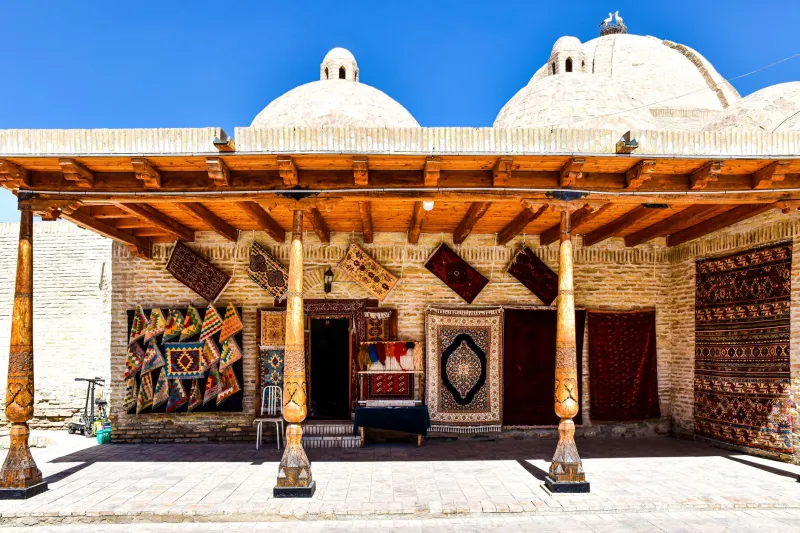
Weaving is another surviving tradition. Gaziantep was historically a center for silk weaving — a direct consequence of its position on the Silk Road — and while industrial production has changed the economics of the craft, traditional textile work persists in the region. The patterns and techniques carry visual echoes of Persian and Arab design traditions absorbed during centuries of trade contact.
These aren't museum exhibits. They're living industries, still employing local families, still producing goods that people actually use. That continuity is part of what makes Gaziantep feel different from many heritage tourism destinations — the past here isn't behind glass.
What All of This Means for the Food on Your Plate
When you sit down to a bowl of beyran soup in Gaziantep — that deeply savory lamb broth with rice and clarified butter — you're eating something that didn't spring from a single culinary tradition. The slow-cooked meat technique has echoes of Levantine cooking. The use of clarified butter connects to both Persian and Ottoman kitchen practices. The red pepper garnish reflects centuries of spice trade. The whole thing was refined in a specific place, by specific people, over a very long time.
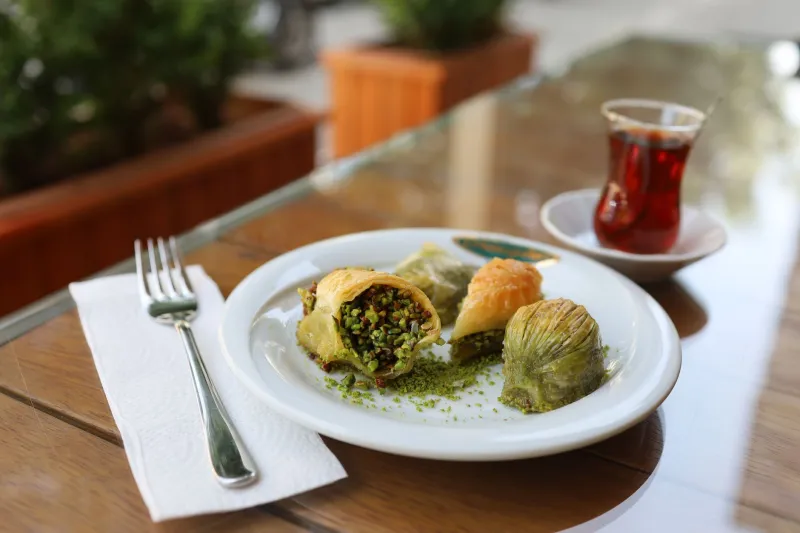
The same is true of baklava. Phyllo dough techniques traveled across the Byzantine and Ottoman empires. The use of pistachios is hyperlocal — Gaziantep's variety is genuinely different from others grown elsewhere. The syrup ratios, the layering method, the specific way the pastry is cut — all of it was developed and perfected in this city, in these workshops, by bakers who learned from their parents who learned from theirs.
Gaziantep's food didn't become great because of a single genius chef or a single cultural tradition. It became great because the city spent two millennia at the intersection of the world's most important trade routes, absorbing, adapting, and refining everything that passed through.
That's a history worth tasting.