Every Bite Tells a Story: How a Gaziantep Morning Table Became the World's Most Delicious History Lesson
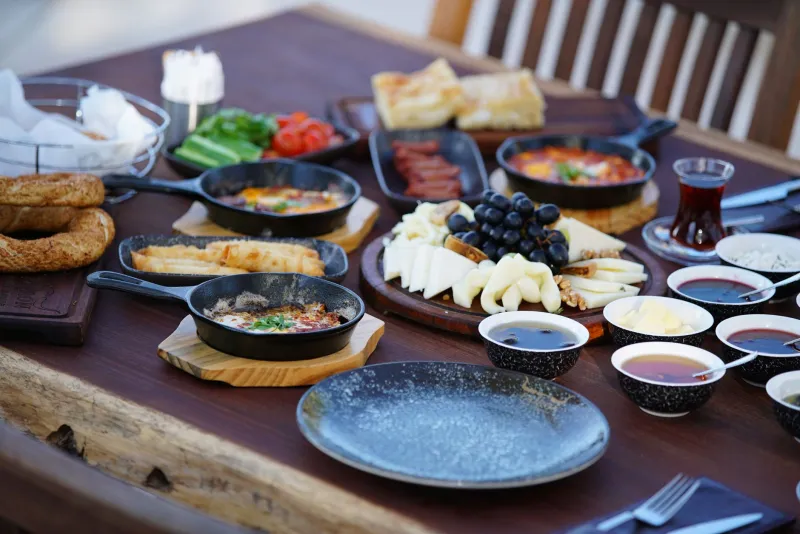
Most of us think of breakfast as a pretty forgettable part of the day. Grab a coffee, maybe some toast, get on with it. But in Gaziantep, breakfast is something else entirely — a slow, deliberate ritual involving a dozen or more small dishes arranged with almost ceremonial care. And here's the part that might genuinely blow your mind: scholars are now treating that morning table as a kind of edible archaeological record, one that maps the movement of people, goods, and ideas across the ancient world.
If you've never thought about your eggs and toast in terms of trade route history, welcome to Gaziantep. Things are different here.
What's Actually on the Table
Before we get into the history lesson, it helps to understand what a traditional Gaziantep breakfast actually looks like. Forget the continental spread or the American diner plate. A proper Antep kahvaltısı — that's the local term — might include six or eight varieties of white cheese, each with a slightly different texture and brine level. There'll be a small dish of local olive oil, dark and grassy, alongside a jar of grape molasses called pekmez. Fresh-baked bread arrives warm. Olives, both cured and fresh. Dried herbs. Eggs cooked simply, sometimes with tomatoes. Sujuk — a spiced, dried sausage — pan-fried until the edges go crispy. Honey so thick it barely pours.
It sounds like a lot, and it is. But the variety isn't just about abundance. According to food historians who've studied the region, each component has a story that stretches back centuries.
The Silk Road Is Sitting on Your Breakfast Plate
Gaziantep sits at what was, for a very long time, one of the most strategically important crossroads in the ancient world. Caravans moving between the Mediterranean coast and Central Asia passed through or near the city. Traders from Persia, Arabia, the Byzantine Empire, and the Levant all left traces here — and not just in the architecture.
Dr. Ayşe Kırca, a food anthropologist who has spent years studying culinary traditions across southeastern Turkey, describes the Gaziantep breakfast table as a kind of "living archive." The grape molasses, for instance, traces back to winemaking traditions that predate Islam in the region. The brined cheeses reflect techniques shared across a broad swath of the ancient Near East, from what is now Syria to the Greek islands. The spicing in sujuk carries echoes of Persian and Central Asian flavor profiles that moved westward with merchant communities over hundreds of years.
"When you look at the variety of preserved and fermented items on a traditional Antep breakfast table," Kırca has noted in her research, "you're looking at a map of which preservation techniques survived in this specific climate, from which trading partners they arrived, and which ones got absorbed into the local food culture permanently."
That's a remarkable thing to think about while you're spreading molasses on fresh bread at 8 in the morning.
Cheese as Cultural Fingerprint
The cheese situation in Gaziantep deserves its own paragraph, honestly. Americans are used to thinking about cheese in terms of regions — cheddar from England, parmesan from Italy, gouda from the Netherlands. But in Gaziantep, the cheese variety on a single breakfast table tells a story about the city's position as a meeting point rather than a single-origin culture.
Some of the cheeses are fresh and mild, similar to styles found across the Levant and into Lebanon and Syria. Others are aged and salty, reflecting preservation techniques suited to the caravan trade — foods that needed to travel well and last long. A few incorporate herbs or spices that point toward trade with Persian merchants. Food historians use these variations to argue that Gaziantep wasn't simply a stop on the Silk Road — it was a place where multiple culinary traditions genuinely merged and evolved together.
That's a distinction that matters. Plenty of cities were passed through. Gaziantep absorbed.
Why Breakfast Specifically?
You might wonder why historians focus on breakfast rather than, say, the elaborate dinner dishes Gaziantep is also famous for. The answer is actually pretty intuitive once you hear it: breakfast is the most conservative meal in any food culture. It changes the slowest. Dinner traditions evolve with wealth, fashion, and access to new ingredients. But breakfast — the first meal of the day, the one eaten at home, often prepared by the same hands that learned from the generation before — tends to hold onto older patterns.
This is exactly what makes it such a useful historical tool. The items on a Gaziantep breakfast table in 2024 share significant structural similarities with what food historians can reconstruct from medieval accounts of the region. That continuity is rare. And it's what makes the morning meal here not just delicious, but genuinely informative.
What This Means for American Visitors
If you're planning a trip to Gaziantep — and you should be — make absolutely sure you don't skip breakfast. Not just because it's exceptional food, which it is, but because you'll be eating in a way that connects you to something much older than the restaurant or guesthouse you're sitting in.
Many traditional guesthouses in the city serve full kahvaltı spreads, and some family-run spots offer breakfast experiences where the host will walk you through what each dish is and where it comes from. Take them up on it. Ask questions. The people of Gaziantep are proud of this tradition and happy to share it.
And if you find yourself reaching for that grape molasses — dark, dense, slightly tangy — just know that you're tasting something that merchants were trading in this same corner of the world more than a thousand years ago. Some history books you read. This one, you eat.
A Final Thought
Food historians have a phrase for the way eating habits outlast the civilizations that created them: "culinary memory." Gaziantep's breakfast table is one of the richest examples of that phenomenon anywhere in the world. It's not a museum exhibit or a reconstructed historical experience. It's just Tuesday morning in a city that never forgot where it came from.
That's pretty extraordinary. And it goes great with coffee.