Copper, Flame, and Family: The Sacred Cookware Traditions That Define a Gaziantep Kitchen
Walk into any serious kitchen in Gaziantep — whether it's a celebrated restaurant tucked into the old bazaar district or a home where four generations still gather for Sunday lunch — and you'll notice something hanging on the walls or stacked deliberately near the stove. Copper. Lots of it. Dented in places, darkened with decades of use, and absolutely not for sale.
For American home cooks who've built their kitchen arsenals around cast iron Lodge skillets or All-Clad stainless, the idea that a cooking pot could carry emotional weight might seem a little dramatic. But spend even a few days in Gaziantep, and you start to understand that here, cookware isn't equipment. It's inheritance.
What We're Actually Talking About: The Big Three
Before diving into the culture, it helps to know the players. Gaziantep kitchens revolve around three copper essentials that you'll encounter everywhere from street food stalls to formal family dinners.
The tava is a wide, shallow copper pan used for everything from slow-cooked lamb dishes to the city's legendary egg-and-meat breakfasts. Its broad surface area distributes heat in a way that, locals will tell you with complete seriousness, cannot be replicated by anything made in the last fifty years.
The sahan — a deeper, rounded vessel with a fitted lid — is the workhorse of Gaziantep's long-simmered stews and legume dishes. The lid isn't just a cover; it's part of a pressure-and-moisture system that experienced cooks learn to read like a language.
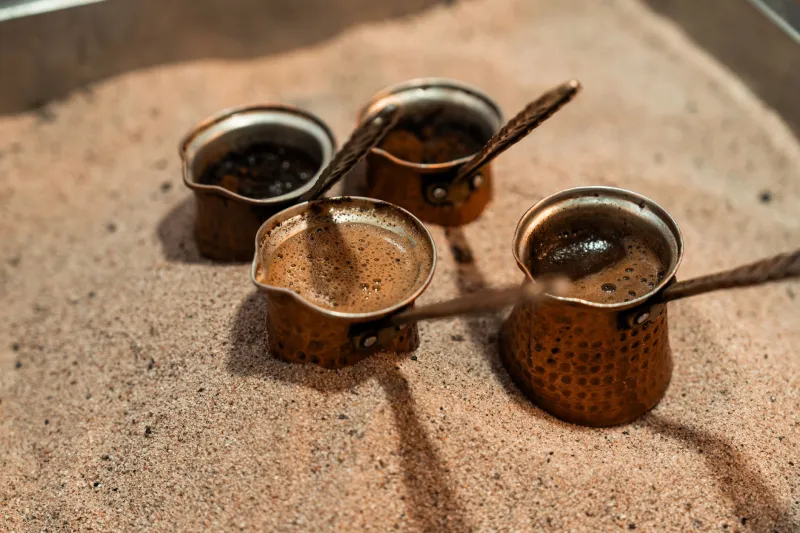
And then there's the cezve, the small long-handled pot used to brew Turkish coffee. If you've ever had properly made Turkish coffee in the U.S. — and most of us haven't — you already know the cezve is non-negotiable. In Gaziantep, it's practically a rite of passage.
The Apprenticeship of Ownership
Mehmet Usta, a coppersmith working out of a narrow workshop near the Zincirli Bedesten covered market, has been shaping and retinning copper cookware for over thirty years. His hands are calloused in specific places that tell the whole story of his trade.
"Young people come in sometimes wanting to buy a tava as a gift," he says, gesturing toward a row of gleaming new pans. "I always ask them: who taught you to cook? Because the pan and the cook have to grow together."
That idea — that cookware and cook develop a relationship over time — comes up again and again in Gaziantep. It's not mysticism. There's practical logic underneath it. Copper conducts heat faster and more evenly than most modern alternatives, but it also requires management. You learn your pan's hot spots. You learn how it behaves with different flame intensities. You season it mentally, not just physically.
Local families describe receiving copper pieces the way Americans might talk about inheriting a grandmother's cast iron skillet — except with considerably more ceremony. Daughters in Gaziantep have traditionally received copper cookware as part of a çeyiz, a trousseau assembled over years before marriage. A well-curated set wasn't just practical; it signaled that a family took cooking seriously.
Why Non-Stick Is Basically a Bad Word Here
Bring up Teflon in the wrong Gaziantep kitchen and you might get a look usually reserved for people who put ketchup on kebab. The resistance to non-stick cookware isn't just generational stubbornness — experienced cooks here will walk you through the actual flavor argument.
Copper's reactivity, they explain, creates a specific kind of fond — the browned bits that stick and release during cooking — that forms the backbone of Gaziantep's deeply savory dishes. The city's cuisine depends on layering. Fat goes in first, aromatics follow, then meat or vegetables, and at each stage, the copper pan is responding to heat in ways that build complexity.
Non-stick surfaces, by design, prevent that sticking. And in preventing the stick, they prevent the story.
"My mother's sahan has a dark ring on the bottom that took twenty years to develop," says Fatma, a home cook who runs informal cooking sessions for visitors out of her apartment in the Şahinbey neighborhood. "That ring is flavor. It's memory. You don't wash it away and you definitely don't replace it with something from a catalog."
The Retinning Ritual
Copper cookware does require one significant maintenance step that most Americans have never heard of: retinning. Because copper can react with acidic foods in ways that aren't great for human health, the interior of copper pots and pans is traditionally lined with tin. Over years of use, that tin lining wears down and needs to be refreshed — a process called kalaylamak in Turkish.
Mehmet Usta performs this service regularly for families throughout the city, and he describes it with the language of restoration rather than repair. "When someone brings me their grandmother's tava for retinning, they're not fixing a broken thing. They're keeping a living thing alive."
The retinning process involves cleaning the copper surface, melting tin onto it, and buffing it smooth — a skilled job that takes years to master. For visitors to Gaziantep, watching a craftsman work in one of the old bazaar workshops is genuinely one of the more memorable experiences the city offers, even if you're not in the market for cookware.
What This Means for Your Trip
If you're planning a visit to Gaziantep — and honestly, you should be — the copper culture offers a few specific experiences worth seeking out.
The Bakırcılar Çarşısı, or Coppersmiths' Bazaar, remains one of the more atmospheric corners of the city's historic market district. Even if you're just browsing, the workshops are open and craftspeople are generally happy to talk about their work. A small cezve makes a genuinely meaningful souvenir — more meaningful than a magnet, anyway — and it'll actually change your morning coffee routine back home.
Some of Gaziantep's cooking class experiences, increasingly popular with international visitors, specifically incorporate traditional copper cookware into their curriculum. Learning to manage a tava over an open flame, under the guidance of someone who's been doing it since childhood, reframes the whole idea of what cooking technique actually means.
And when you sit down to eat in the city — at a family-style lokanta or a more formal kebab house — notice the vessels your food arrives in. Chances are good that what's keeping your stew warm is older than your parents, and has fed more people than you'll ever meet.
The Bigger Picture
Gaziantep's relationship with its copper cookware is, at its core, a story about continuity. In a world where kitchen gadgets have a roughly three-year shelf life and "upgrade" is treated as an unqualified good, this city has quietly maintained a different philosophy: that the best tools are the ones you've learned, and the ones you pass on.
For American visitors accustomed to treating kitchenware as disposable, that perspective can feel genuinely revelatory. Not preachy — nobody in Gaziantep is lecturing tourists about their InstaPots — but quietly, compellingly different.
The copper doesn't lie. And in Gaziantep, that's exactly the point.