You Can't Understand Gaziantep's Food Until You Understand Its Streets
Most people who visit Gaziantep come for the food. They leave with something unexpected: a completely different understanding of how cities work. Because in Gaziantep, the streets aren't just the thing you walk through to get to the restaurant. The streets are part of the recipe.
This sounds like a metaphor. It isn't. The physical layout of this city — its elevation changes, its neighborhood divisions, its ancient bazaar logic, the way its lanes narrow and open and narrow again — has been directly shaping what people cook, sell, and eat here for more than a thousand years. Understanding that relationship is the difference between visiting Gaziantep and actually reading it.
The Castle at the Center of Everything
Start at the top, literally. Gaziantep's volcanic basalt castle sits on a rise in the heart of the old city, and everything in the historic core radiates outward from it in the organic, improvised way that pre-modern cities tend to grow. There was no grid planner, no master blueprint. Settlement followed water sources, trade routes, and the logic of defense — and the result is a city that moves in curves and angles rather than straight lines.
That geometry matters for food. In a grid city, neighborhoods are defined by blocks and avenues. In Gaziantep's old quarters, they're defined by the physical features of the land and by the hans — the large courtyard structures that served as combined warehouse, marketplace, and inn along the old caravan routes. Each han anchored a specific trade. And the trades that clustered around food production created micro-environments where particular culinary traditions took root and stayed.
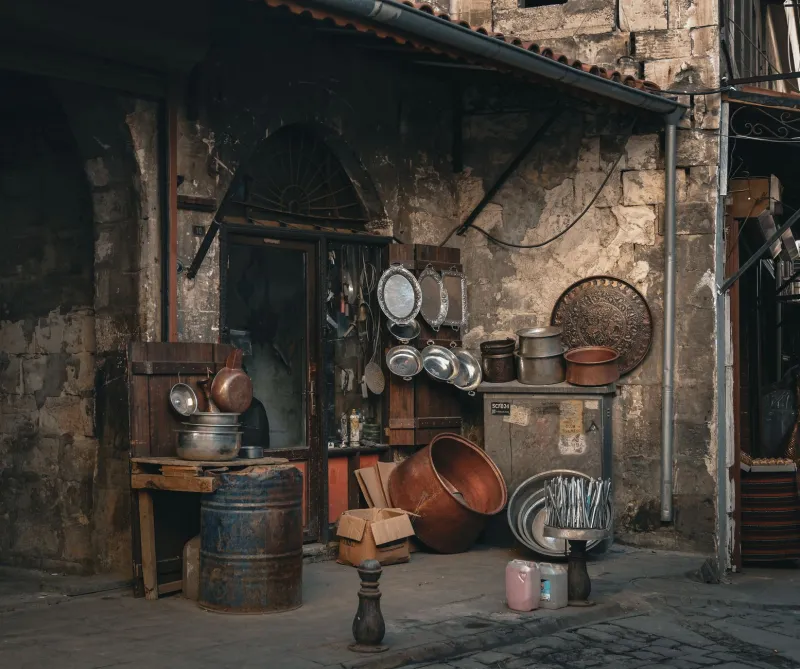
The copper merchants who made the city's distinctive cookware weren't randomly placed. They were positioned in relation to the metalworking heat sources, the water access, and the proximity to the bazaar sections where their customers — cooks, households, restaurant owners — would naturally pass. The spice traders occupied corridors that connected the incoming caravan routes to the central market. The relationship between where things were made and where they were sold created the physical logic of the city, and that logic shaped what got made.
Neighborhood Identity as Culinary Identity
Gaziantep's old residential neighborhoods — called mahalleler — each had their own character, their own dominant trades, and their own food traditions. This wasn't incidental. It was structural. Neighborhoods organized around particular ethnic or religious communities, or around specific craft guilds, developed their own variations on shared dishes, their own preferred ingredients, their own seasonal rhythms.
Some of those distinctions survive today in ways that locals navigate almost unconsciously. Ask a Gaziantep native where to get the best lahmacun and they won't just name a restaurant — they'll often name a neighborhood first, because the neighborhood carries a reputation that the individual shop inherits. Ask about beyran, the city's famous early-morning lamb soup, and you'll find that certain parts of the old city claim a particular relationship to the dish, a specific preparation style that reflects the history of who lived there and what they had access to.
For visitors, this creates a kind of edible map. The city can be navigated through food landmarks in a way that reveals its history more vividly than any museum placard. The narrow lane that smells of roasting pepper paste in late summer tells you something about the agricultural calendar and the preservation traditions that developed before refrigeration. The bakery tucked into a residential alley that doesn't have a sign — because it's never needed one — tells you something about how commerce and community were once indistinguishable.
The Bazaar Corridor as Culinary Engine
Gaziantep's covered bazaar district, centered around the historic Zincirli Bedesten, is one of the most functionally coherent commercial spaces in Turkey. It's not a tourist market dressed up to look old. It's an actual working bazaar where real commerce happens, and its internal logic — which vendors go where, which goods cluster together — reflects centuries of accumulated practical knowledge about how trade works.
For food, the bazaar functions as a kind of living pantry for the city. The dried pepper and tomato paste vendors, the nut merchants with their towering displays of pistachios and walnuts, the shops selling clarified butter and dried herbs — these aren't arranged randomly. Their proximity to each other, and to the hans where wholesale transactions happen, creates a geography of ingredients that has historically determined what combination of flavors was most accessible to a cook on any given day.
There's a reason Gaziantep's cuisine uses certain flavor combinations so consistently — the marriage of pistachio and clarified butter, the pairing of dried red pepper with lamb, the particular way that pomegranate molasses shows up across dozens of different dishes. Those combinations aren't just tradition. They're the logical output of what was always available, always proximate, always affordable in the bazaar corridors where cooks shopped.
Reading the Streets Like a Local
One of the most useful things you can do in Gaziantep is walk before you eat. Spend a morning in the old city without a specific restaurant destination, just following the lanes and paying attention to what you smell and hear and see. You'll notice that the city announces its food before you find it — the charcoal smoke from a kebab grill drifting through a courtyard, the sound of a copper tray being hammered in a workshop next to a kitchen supply shop, the particular golden light that falls into a han at mid-morning when the spice merchants are restocking their displays.
This sensory reading of the city is something locals do without thinking about it. They know which time of day certain smells appear in certain streets. They know that the bread is freshest at a particular bakery on a particular morning because they've been walking past it their whole lives. That accumulated knowledge — passed down through families, embedded in neighborhood memory — is itself a form of culinary heritage, as important as any recipe.
For visitors from the US, where our cities are often designed to separate the experience of food from the experience of space — where restaurants exist in commercial zones, grocery stores in retail strips, and homes somewhere else entirely — Gaziantep's integration of cooking, commerce, and daily life into a single physical fabric can feel almost disorienting. In the best possible way.
The streets made the food. Walk them long enough, and you'll start to taste the difference.