The Recipe Nobody Wrote Down: How Gaziantep's Three-Generation Kitchen Creates Food That Can't Be Copied
Photo: Turkish grandmother mother daughter cooking together traditional kitchen, via i.pinimg.com
Ask a Gaziantep grandmother for her beyran recipe and she'll tell you, more or less. She'll list the lamb, the rice, the spices, the broth. She'll describe the process with patience and generosity. What she won't be able to tell you — what she genuinely cannot articulate — is the part that actually makes it taste the way it does.
That part doesn't have words. It lives in her hands.
This is the central truth of Gaziantep's food culture, the thing that separates it from every culinary tradition that can be packaged, exported, or recreated from a YouTube tutorial. The city's cooking is not primarily a collection of recipes. It's a living transmission — grandmother to mother to daughter, generation by generation, in kitchens that function as something closer to graduate schools than home cooking spaces.
What "Teaching" Actually Looks Like
In American culture, we tend to think of cooking instruction as explicit: here's the recipe, here's the technique, here's the measurement. Even our most revered culinary traditions — the Thanksgiving turkey, the family chili — get written down eventually, posted to a family blog, texted in a group chat.
In a traditional Gaziantep kitchen, that's not how knowledge moves.
A girl grows up watching. She absorbs the rhythm of her grandmother's hands kneading dough before she can name what she's seeing. She learns to gauge the heat of a copper pot by the sound the oil makes, not by a thermometer. She understands — without ever being explicitly taught — that the pepper paste needs to cook until it smells a particular way, and that "a particular way" is something she has filed away in her sensory memory since childhood.
This is what food anthropologists sometimes call embodied knowledge. It's not stored in the brain the way a recipe is stored. It's stored in the body. And the only way to acquire it is to be physically present, repeatedly, over years.
The Three Layers of a Gaziantep Kitchen
In the most traditional Gaziantep households, the kitchen operates across three distinct generations simultaneously — each with a different role that isn't assigned so much as understood.
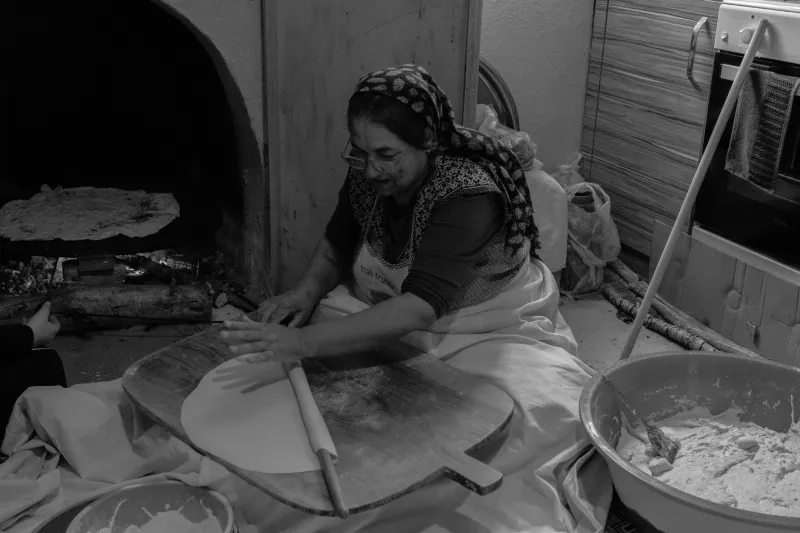
The grandmother (büyükanne) is the authority. She doesn't necessarily do the most physical work anymore, but her presence shapes every decision. She tastes, she adjusts, she occasionally takes over a task without explanation when she senses it going wrong. Her corrections are rarely verbal. She'll simply move a younger pair of hands to a slightly different angle on the rolling pin, or add a pinch of something to the pot without comment.
The mother occupies the middle space — competent, confident in the core techniques, but still learning the higher registers of the grandmother's knowledge. She's the one translating between generations, bridging the grandmother's intuition and the daughter's inexperience.
The daughter, meanwhile, is doing what looks like helping but is actually something more important: she's building the sensory archive that will inform her cooking for the rest of her life. She's learning what good smells like. She's learning the weight of properly rested dough. She's learning, without knowing she's learning.
The Unwritten Rules
Beyond technique, the multigenerational kitchen transmits something harder to name — a set of values and standards that function as quality control for the entire tradition.
In Gaziantep cooking culture, there's a concept that translates roughly as "the food must be made with love" — but that phrase, familiar enough in American food writing, means something more specific here. It refers to a standard of attention and care that is considered non-negotiable. You don't rush a slow-cooked dish because you're tired. You don't substitute an inferior ingredient because the good one requires an extra trip to the market. The food deserves your full effort, every time, because the people eating it deserve your full effort.
This standard is enforced not through explicit criticism but through the grandmother's silence when something is done well and her almost imperceptible shift in energy when it isn't. In a culture where cooking is a form of love expression, falling short of the standard isn't a culinary failure — it's something more personal.
What This Means for Travelers
Understanding the multigenerational kitchen changes how you experience Gaziantep's food as a visitor. The meal you eat at a family-run restaurant isn't just dinner — it's the end product of a decades-long educational process that began in someone's grandmother's kitchen. The flavors on your plate carry the accumulated adjustments of multiple generations, each one refining what they inherited.
This is also why the food resists replication in ways that go beyond ingredients or technique. Even the most talented American chef, working with authentic Gaziantep pistachios and locally sourced isot pepper, cannot reproduce a dish that has been refined across three generations of embodied, intuitive knowledge. Something is always missing — not as a failure of skill, but as a function of how the knowledge was acquired and stored.
For travelers, the appropriate response to this isn't frustration. It's awe. And maybe, if you're lucky enough to be invited into a family home during your visit, it's the quiet, attentive presence of someone who understands they're in the presence of something genuinely irreplaceable.
The Future of the Three-Generation Kitchen
It would be dishonest to write this without acknowledging the pressure this tradition faces. Younger generations in Gaziantep, like young people everywhere, are navigating the tension between inherited culture and modern life. Urban apartments don't always have the kitchen space for three-generation cooking. Careers pull families apart. The grandmother who once anchored the kitchen is sometimes now a phone call away rather than a presence at the stove.
But Gaziantep's food culture has shown a remarkable resilience — in part because the city itself understands what's at stake. The food isn't just a pleasure. It's an identity. And as long as there are grandmothers willing to guide a younger pair of hands to exactly the right angle on the rolling pin, the tradition will find a way to survive.