The Invisible Ingredient: How Gaziantep's Ancient Water Supply Quietly Built a Food Culture
When food writers talk about what makes Gaziantep's cuisine exceptional, the usual suspects come up quickly: the pistachios, the red pepper paste, the copper-pot traditions, the generations of home cooks who never wrote anything down. Water almost never makes the list. That's a significant omission.
Understanding what's actually in Gaziantep's water — and where it comes from — reframes the entire story of how this city became one of the world's great food destinations. It's a geological story as much as a culinary one, and it starts deep underground.
What's Underneath Gaziantep
Gaziantep sits on the northern edge of the Mesopotamian plain, where the Taurus Mountains begin their descent toward the Euphrates River basin. This geography isn't just scenic. It creates a specific hydrological environment: rainwater and snowmelt filter down through layers of limestone, basalt, and sedimentary rock before emerging as springs and feeding the city's groundwater table.
That filtration process takes years — sometimes decades. By the time the water surfaces or gets drawn from wells, it carries a mineral signature that reflects everything it's passed through. In Gaziantep's case, that means elevated levels of calcium and magnesium (the minerals that define water "hardness") alongside trace elements that vary by neighborhood and depth.
This isn't exotic or unusual in isolation. Plenty of cities sit on mineral-rich aquifers. What makes Gaziantep distinctive is the specific balance — hard enough to contribute to flavor and texture, not so hard that it creates problems. It's the culinary equivalent of a well-seasoned cast iron pan: the mineral history is built in, and it does work that a neutral surface simply can't.
Bread That Behaves Differently
Ask a Gaziantep baker why their bread has a different crumb structure than bread made with the same flour in Istanbul or Ankara, and you might get a shrug. They know it's different. They don't always have language for why.
The answer, at least in part, is mineral content. Calcium in water strengthens gluten networks, which affects how dough develops, rises, and holds its shape during baking. The specific mineral balance in Gaziantep's water produces a tighter, more elastic gluten structure — which translates to bread with better crust development, a chewier interior, and a longer shelf life.
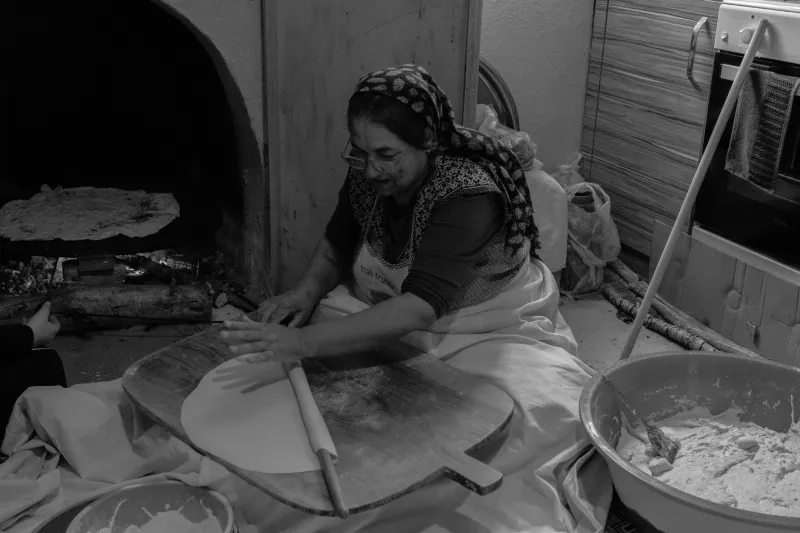
This matters enormously in a cuisine where bread isn't a side item — it's a utensil, a vehicle, a structural element. The flatbreads used to wrap kebabs, the thicker loaves torn apart at the breakfast table, the thin dough bases for lahmacun — all of them perform slightly differently here than anywhere else, and water is a significant reason why.
Fermentation and the Mineral Factor
Gaziantep's pickle culture is serious business. The city's turşu — fermented vegetables ranging from hot peppers to green tomatoes to eggplant stuffed with herbs — are considered among the finest in Turkey, and local families guard their recipes with the same energy that American BBQ families guard their rub formulas.
What rarely gets discussed is how water quality shapes fermentation outcomes. The mineral content of the brine water directly affects how quickly lactic acid bacteria establish themselves, how evenly fermentation proceeds, and ultimately how the pickles taste. Calcium, in particular, helps vegetables maintain their crunch through the fermentation process — it strengthens the pectin in cell walls, preventing the mushy texture that plagues poorly made pickles.
Gaziantep's naturally hard water gives its fermentation culture a built-in advantage. Families using local well water or municipal water drawn from regional aquifers are essentially starting with a brine that's already partially optimized. Recreate the same recipe in Chicago or Phoenix tap water, and you're working against that baseline from the start.
This is one of the most concrete explanations for why recipes that work perfectly in Gaziantep produce slightly disappointing results when American home cooks try to replicate them. It's not technique. It's chemistry.
The Springs That Shaped the City's Layout
Historically, Gaziantep's settlement patterns followed water. The city's oldest neighborhoods cluster around natural spring sources, and the locations of ancient caravanserais — the rest stops that made Gaziantep a commercial hub on Silk Road trade routes — were determined in large part by water access.
This isn't just historical trivia. It means the city's food culture developed in specific geographic pockets, each with slightly different water characteristics. The neighborhoods closest to certain spring sources developed distinct fermentation and cooking traditions, and those micro-regional differences persist even today in how families in different parts of the city approach the same recipes.
Food historians studying Gaziantep have noted that certain dishes are strongly associated with specific neighborhoods — not just because of family tradition, but because the water available in those areas produced consistently different results. The city is, in a very real sense, a patchwork of micro-terroirs.
What This Means for American Home Cooks
If you've tried to cook Gaziantep recipes at home and felt like something was fundamentally off — not wrong, exactly, just not quite right — water is worth investigating before you blame your technique.
A few practical approaches:
Test your tap water. Inexpensive water testing kits are available at hardware stores and online. You're looking at hardness (measured in ppm or mg/L of calcium carbonate). Gaziantep's water runs moderately hard — roughly in the 150–250 mg/L range. Soft water cities like Seattle or Portland (often below 50 mg/L) will produce noticeably different results in dough and fermentation.
Use mineral water for specific applications. For bread baking and pickling especially, a mineral water with moderate hardness (look at the label — brands like Gerolsteiner or certain spring waters list mineral content) can meaningfully shift your results.
Don't filter everything. Reverse osmosis systems strip water nearly bare. If you're cooking Turkish recipes, that stripped water is working against you. A carbon filter that removes chlorine while leaving minerals intact is a better choice.
A Reason to Visit That Nobody Advertises
There's something quietly profound about understanding that Gaziantep's food culture was shaped, in part, by what's underground. The springs that fed the city's ancient cisterns, the aquifers that watered its orchards, the mineral-rich water that moved through its copper pipes and ceramic vessels — all of it left traces in the food that emerged.
When you eat in Gaziantep, you're tasting geology as much as cooking. The bread, the pickles, the slow-cooked stews, even the coffee — they all carry a faint signature of the earth they came from. That's not something you can buy at a specialty store or download from a recipe blog. It's one more reason why the city itself is irreplaceable, and why the food always tastes better there than anywhere you try to recreate it.